Ghana's Food Import Crisis: How GH¢36bn Annually on Chicken, Rice and Sugar Exposes Agricultural Vulnerability
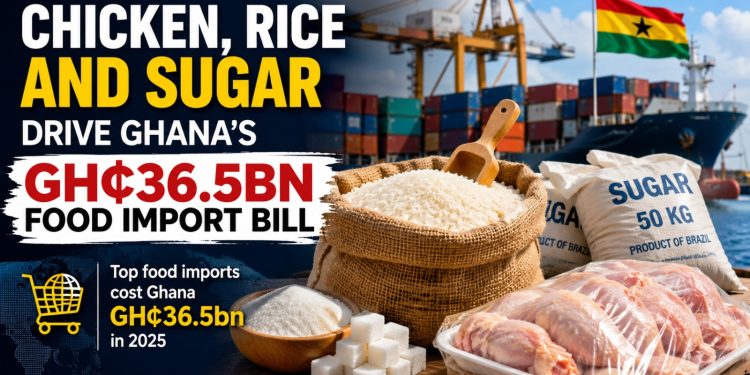
Ghana's reliance on imported food has reached a critical level, with the country spending more than GH¢36.5 billion annually to meet its food consumption needs. New data from the Ghana Statistical Service reveals a troubling dependency on foreign suppliers for essential commodities, even as the nation struggles with agricultural development and food security challenges.
According to the latest Annual International Merchandise Trade Statistics Report, processed cereal grains emerged as the single largest food import category, costing GH¢2.94 billion and representing 8.1 percent of the total food import bill. Frozen chicken followed closely at GH¢2.84 billion, while animal by-products such as guts, bladders and stomachs accounted for GH¢2.72 billion. Rice—a staple consumed daily across Ghanaian households—constituted a significant portion, with semi-milled and wholly milled rice costing GH¢2.39 billion and broken rice adding another GH¢1.19 billion to the import bill.
These four categories alone account for approximately 30 percent of Ghana's total food import expenditure, highlighting the country's heavy dependence on imported staples and protein products. Beyond these top items, sugar, frozen fish, palm oil, mangoes and shea nuts also feature prominently among major food imports, compounding pressure on foreign exchange reserves.
Why This Matters for Ghana
The scale of Ghana's food import bill carries serious implications for the national economy and food security. Every cedi spent on imported food represents money flowing out of the country that could otherwise support local farmers, rural employment and domestic agricultural development. This pattern has persisted despite repeated government calls for import substitution and increased domestic production.
The heavy reliance on imported chicken and rice is particularly concerning given that both products can be competitively produced within Ghana. Local poultry farmers struggle to compete with cheap frozen imports, whilst rice cultivation has significant potential in regions like the Northern and Upper regions. Similarly, processed grains represent value that could be captured locally through domestic milling and food processing industries.
Beyond immediate economic concerns, this import dependency creates vulnerability. Supply chain disruptions, currency fluctuations or sudden price increases in global markets directly threaten household food security and affordability for ordinary Ghanaians. The situation also strains the country's foreign exchange position at a time when Ghana faces broader fiscal challenges.
The Paradox: Exporting Value, Importing Basics
The data presents a striking contradiction within Ghana's agricultural economy. Whilst the country depends heavily on food imports to feed itself, it simultaneously exports significant volumes of processed cocoa products, cashew nuts, tuna and shea-based products. These exports generate crucial foreign exchange and demonstrate Ghana's capacity in agro-processing and value addition.
This imbalance suggests that Ghana possesses the agricultural foundation and processing capabilities to reduce import dependency, yet structural and policy barriers prevent the realisation of this potential. The issue is not merely agricultural production but also market incentives, investment in agricultural infrastructure, supply chain efficiency and policies that protect local producers whilst encouraging domestic consumption of locally-produced foods.
The Ghana Statistical Service report concludes that addressing the import bill requires a multifaceted approach: increasing domestic food production, expanding agro-processing capacity, investing in value addition across the agricultural supply chain, and implementing policies that strengthen food security whilst building a more resilient and self-sufficient agricultural sector. Without meaningful intervention, Ghana's food import bill will likely continue rising, threatening both economic stability and household nutritional security.
Source: The Ghana Report


Comments (0)
Be the first to comment.