Ghana must guard against weaponising religious divisions, Peace Council warns
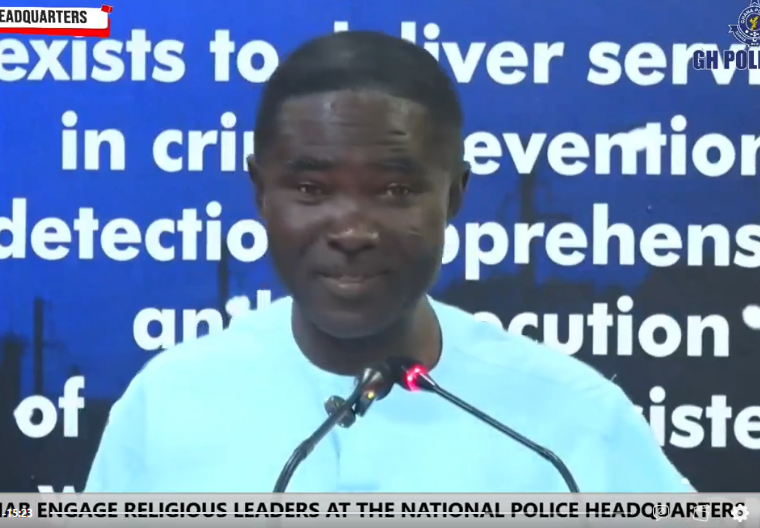
Ghana's religious plurality remains one of the nation's greatest assets, but only if citizens and state institutions remain vigilant against attempts to exploit theological differences for political or social discord, the National Peace Council has warned.
Speaking at a high-level engagement between the Inspector-General of Police and religious leaders at Police Headquarters in Accra on 14 August, George Amoh, Executive Secretary of the National Peace Council, stressed that the country's strength lies in its ability to unite people across Christian, Muslim and other faith communities under a shared national identity.
The appeal comes amid recent incidents that have heightened religious tensions across the country, prompting security and community leaders to reaffirm Ghana's commitment to peaceful coexistence.
A Pattern of Tension Requires Systemic Response
Mr Amoh acknowledged that the Police responded swiftly to contain recent flashpoints, demonstrating the critical role state institutions play in preventing minor disputes from escalating into broader social conflict. However, he cautioned that Ghana cannot become complacent. "Disagreements and acts of deviance are inevitable in every growing society," he noted, emphasising that the nation must develop robust mechanisms to manage tensions before they spiral.
A central message from the Peace Council was unambiguous: violence cannot beget peace. Citizens and leaders must abandon the logic of retaliatory conduct and instead embrace dialogue and lawful grievance processes. The Council stressed that provocative behaviour—regardless of its religious framing—should never justify violent responses.
Why It Matters for Ghana
Ghana's constitutional architecture and democratic institutions have been built explicitly around the principle of religious freedom and coexistence. Unlike some neighbouring countries, Ghana has maintained relative stability despite its religious diversity, a fact that reflects both historical fortune and deliberate institutional design.
However, that stability cannot be assumed permanent. As urbanisation, social media amplification and political competition intensify, religious identity can become a convenient vehicle for mobilising supporters or deflecting accountability. The Peace Council's intervention suggests that authorities are alert to this risk.
For ordinary Ghanaians, the message is straightforward: Christian-Muslim unity is not merely a rhetorical ideal but a practical necessity for national security and economic progress. Religious leaders, too, bear responsibility for tempering inflammatory rhetoric and modelling restraint within their communities.
Collective Responsibility and the Path Forward
The National Peace Council framed peace-building as a multi-stakeholder responsibility. The Police must maintain capacity and impartiality in responding to incidents. Religious leaders must use their moral authority to preach tolerance. State institutions must enforce the law fairly. And citizens must resist the temptation to weaponise faith for narrow partisan gain.
Ghana's diversity, properly managed, remains a source of cultural richness, intellectual exchange and economic dynamism. The challenge ahead lies not in eliminating disagreement—which is inevitable in any pluralistic society—but in ensuring that disagreement never metastasises into the kind of communal violence that has devastated other nations.
The National Peace Council's warning serves as a timely reminder that Ghana's peace is not self-sustaining. It requires constant vigilance, dialogue and the collective commitment of all citizens to prioritise national unity over sectarian advantage.
Source: MyJoyOnline



Comments (0)
Be the first to comment.