
From Jubilee to the Green Transition: The State of Ghana's Oil and Gas Industry
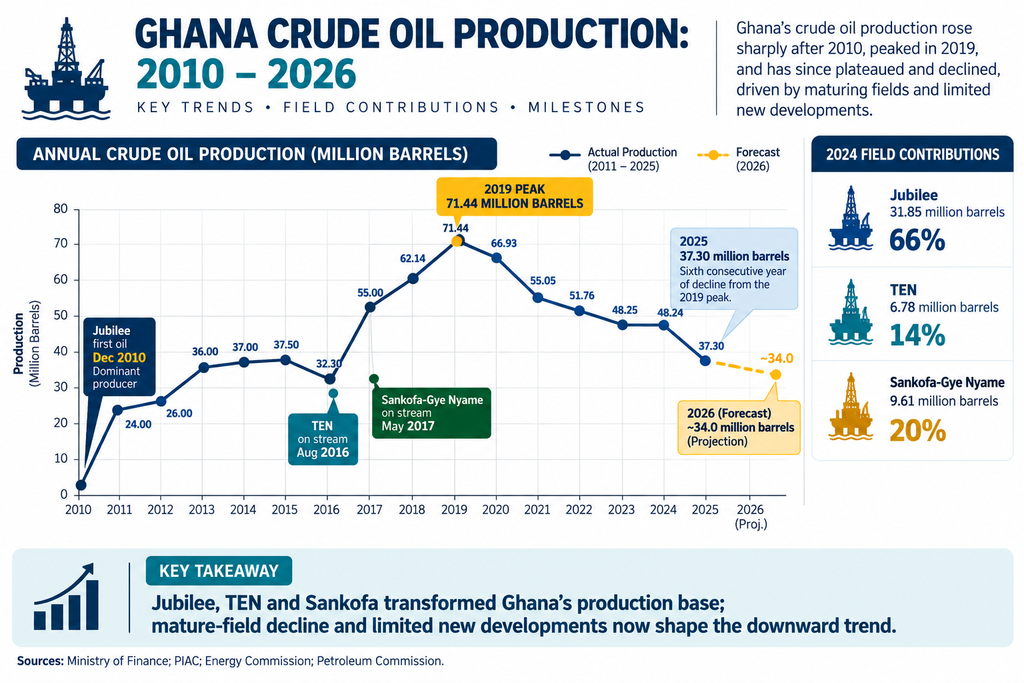

More than a decade after Ghana celebrated its first oil in December 2010, the country's petroleum industry stands at a crossroads. What began as a transformative discovery in the deep waters off the Western Region has grown into a complex, multi-field operation generating billions of dollars in government revenue — yet the sector now grapples with declining production rates, evolving regulations, and the looming demands of a global green economy.
How Ghana's oil industry was built
The institutional backbone of Ghana's petroleum sector was laid in 1983 with the establishment of the Ghana National Petroleum Corporation (GNPC) under PNDCL 64. The corporation was mandated to lead exploration and production efforts on behalf of the state. For decades, exploratory activity yielded modest results — until 2007, when the discovery of the Jubilee Field in deep offshore waters changed everything.
Ghana formally joined the ranks of African oil producers in December 2010 when it poured its first oil from Jubilee. The TEN fields — Tweneboa, Enyenra and Ntomme — came online in August 2016, followed by the Eni-operated Sankofa Gye Nyame field in mid-2017, part of the Offshore Cape Three Points (OCTP) project. Together, these three major fields transformed Ghana into one of West Africa's notable oil producers and attracted significant foreign direct investment.
The industry is structured across three distinct segments: upstream (exploration and production), midstream (gas processing and transmission), and downstream (refining, storage, distribution and marketing). Each segment is governed by its own regulatory framework and licensing regime, with the Petroleum Commission overseeing upstream activities and the Energy Commission regulating midstream operations.
Production figures tell a sobering story
The Jubilee Field, operated by Tullow Oil, remains the cornerstone of Ghana's petroleum output. After ramping up rapidly following its 2010 launch, production stabilised at around 100,000 barrels per day by 2014. While infill drilling and the Jubilee South East project have helped slow natural decline, output is estimated at approximately 74,000 barrels per day in 2026 — a significant drop from peak levels.
The TEN fields have experienced steeper declines than initially projected, falling from roughly 64,000 barrels per day in 2018 to an estimated 14,000 barrels per day in 2026. The Sankofa field has fared somewhat better, declining more gradually from a peak of around 53,000 barrels per day in 2018 to approximately 32,000 barrels per day in 2026. Crucially, Sankofa also supplies non-associated gas that feeds Ghana's thermal power plants, making it strategically important beyond crude oil revenues alone.
In the midstream segment, the Ghana National Gas Company (GNGC) has increasingly taken on the role of gas sector aggregator, a function previously designated to GNPC. This regulatory evolution reflects efforts to build a more efficient domestic gas market, particularly as reliable gas supply remains critical to keeping the lights on across the country.
Downstream operations are highly liberalised, with numerous Oil Marketing Companies, Bulk Distributing Companies and Petroleum Service Providers competing in the market. Fuel prices at the pump are determined by a complex formula incorporating ex-refinery prices, various margins, and several statutory levies — including the energy debt recovery levy and the road fund levy — which regularly affect the cost of fuel Ghanaians pay.
Why it matters for Ghana
Oil revenues have been a primary driver of Ghana's foreign direct investment inflows and government receipts since 2010. The sector funded significant public expenditure during its early boom years and remains a material contributor to GDP. However, the trend of declining output from all three major fields raises serious questions about the medium-term revenue outlook, particularly as Ghana continues to manage a heavy public debt burden following the 2022 economic crisis and ongoing IMF-supported recovery programme.
Beyond declining reserves, Ghana faces the broader challenge shared by all fossil-fuel-dependent economies: the global push toward renewable energy and reduced carbon emissions. International oil companies are under growing pressure from shareholders and regulators to cut hydrocarbon investments, which could affect future exploration funding in Ghanaian waters.
For Ghana, the path forward involves maximising the remaining value from existing fields through enhanced recovery techniques, accelerating domestic gas utilisation to reduce power sector costs, and carefully designing a regulatory environment that can attract new upstream investment while also laying the groundwork for a credible energy transition. The decisions made in the coming years will determine whether Ghana's oil wealth leaves a lasting legacy — or becomes a missed opportunity.
- Jubilee Field remains Ghana's largest producer at an estimated 74,000 barrels per day in 2026.
- TEN field output has sharply declined, dropping from 64,000 to around 14,000 barrels per day since 2018.
- GNPC was founded in 1983; Ghana's first commercial oil flowed in December 2010.
Source: MyJoyOnline



Comments (0)
Be the first to comment.