
Beyond the Hype: What Kofi Conduah's Business Legacy Lesson Means for Ghana's Startup Scene
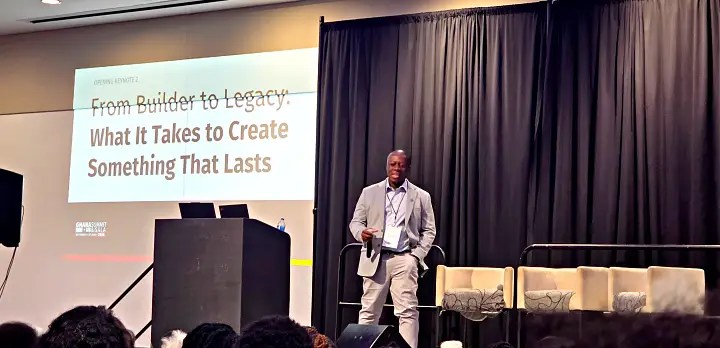

Kofi Conduah, the Ghanaian-born founder of PassportPay and EasAIy Tax, has delivered a sobering message to the continent's entrepreneurial community: most startups are chasing the wrong definition of success. Speaking at the GhanaInnov8 Summit in Atlanta, Conduah argued that groundbreaking ideas, massive funding rounds and headline-grabbing expansion mean nothing if customers won't pay again—a reality that hits particularly close to home for Ghana's burgeoning startup ecosystem, where many ventures collapse despite early promise and investor enthusiasm.
The Uncomfortable Truth About Early Traction
Conduah's central argument challenges a narrative that dominates startup culture globally and increasingly in Ghana. Founders often celebrate their first wave of customers, but Conduah warned that initial adoption frequently reflects support from a founder's personal network—friends, family and professional connections—rather than genuine market demand. "If you do something and the first two months you have a lot of people buying your product or service, those are your friends and family," he explained. "That's not a real business."
This distinction matters profoundly for Ghanaian entrepreneurs navigating a competitive landscape where visibility and early wins can attract local and diaspora investment. The question Conduah poses is deceptively simple yet rarely asked with honesty: will strangers with no connection to you keep buying what you've built? Real business validation, he argued, emerges only when customers outside your immediate circle purchase repeatedly because they perceive genuine value—not loyalty or obligation.
For Ghana's tech ecosystem, where many startups have raised seed funding and achieved local recognition, this principle serves as a crucial reality check. Visibility does not equal viability.
The Sales Problem That Technology Cannot Solve
A second critical lesson from Conduah's address concerns the gap between building and selling. In an era when technical capability has become democratised—when software development, app creation and digital platform launches are increasingly accessible—the real bottleneck is commercial, not technical. "Building a product is not building a business," Conduah stated plainly.
This distinction carries particular weight in Ghana, where technical talent is abundant but sustainable business models remain scarce. A brilliant app, a clever fintech solution or an innovative logistics platform can emerge from Ghana's developer community, but unless there is a repeatable system for acquiring and retaining paying customers, it will never scale. Conduah illustrated the progression: one customer is validation; ten customers suggest potential; but predictable, month-on-month customer acquisition is when scalability begins to emerge. Most importantly, the ultimate goal is removing the founder from every transaction—building a business that runs without personal hustle on every sale.
For Ghanaian startups competing against better-resourced regional and global players, this principle is a competitive advantage waiting to be seized. The founder who masters customer acquisition systems will outpace the founder with superior technology but no sales discipline.
Why It Matters for Ghana
Ghana's startup ecosystem has matured significantly over the past decade. Venture capital flows into the country, incubators and accelerators operate in Accra, and young entrepreneurs are raising millions in funding. Yet failures are common. Companies that achieved prominence fade quietly. This pattern often reflects the exact mistakes Conduah highlighted: confusing early enthusiasm with sustainable demand, prioritising growth over profitability, and automating or scaling fundamentally broken business models.
Conduah's warning about revenue versus profit deserves particular attention. He noted a critical truth: a business can generate substantial revenue and still collapse. The culprit is usually misunderstood unit economics. If the cost of acquiring a customer exceeds the profit generated from that customer's lifetime value, then acquiring more customers simply accelerates the path to failure. "If you automate a mess, you just get a faster loss," Conduah said. "If you scale a failing business, you get a bigger loss."
For Ghana's ambitious founders, especially those receiving investor backing, this principle demands discipline. The temptation to chase growth metrics that impress investors must be resisted if the underlying economics don't work. A startup burning through capital to acquire customers at a loss is not innovating—it's merely spending investor money faster.
Conduah's message ultimately champions a return to entrepreneurial fundamentals: build something people want, create a system to sell it sustainably, and understand the real economics beneath the top-line numbers. For Ghana's next generation of founders, that clarity might prove more valuable than any venture cheque.
Source: Ameyaw Debrah




Comments (0)
Be the first to comment.