State Housing Company orders nationwide property audit; occupants given 21 days to prove legal rights
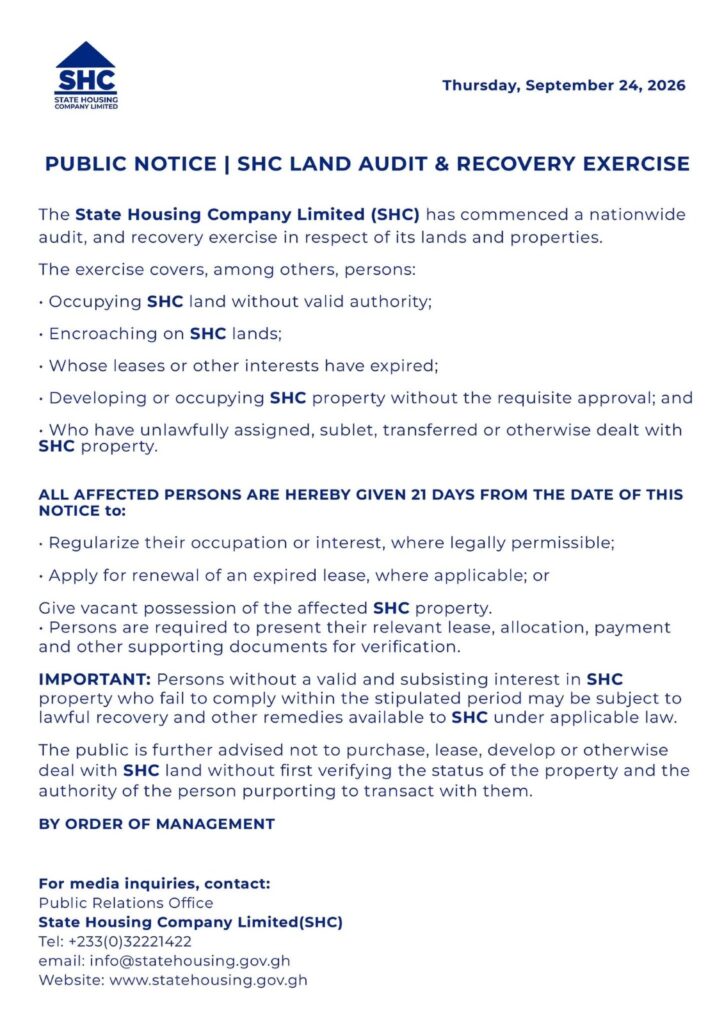
The State Housing Company Limited (SHC) has initiated a sweeping nationwide audit and recovery exercise aimed at identifying individuals and entities occupying or using its properties without proper legal authorisation. The move signals a significant tightening of property management by the state agency, which oversees substantial residential and commercial real estate holdings across Ghana.
Under the exercise, the company is targeting multiple categories of unauthorised occupation and use. These include persons living on SHC lands without valid documentation, individuals who have encroached on company properties, holders of expired leases who continue to occupy premises, and those who have undertaken developments without obtaining required approvals from the company. The audit will also investigate cases of unlawful assignment, subletting, transfer or other dealings in SHC property conducted without proper authority.
Timeline and compliance requirements
Affected occupants and property holders have been given a 21-day window from 24 September 2026 to take corrective action. During this period, individuals must present all relevant documentation including leases, allocation letters, payment proof and other supporting evidence for verification by the company.
Those with expired leases may apply for renewal where legally permissible, whilst those with valid interests can pursue regularisation of their occupation. Property occupants without any legal claim to SHC land must surrender vacant possession within the stipulated timeframe. Failure to comply will leave individuals vulnerable to lawful recovery action and other legal remedies available to the company under Ghana's property laws.
Why this matters for Ghana
Property ownership and land rights remain contested issues in Ghana, with disputes over land frequently ending up in courts. The SHC audit reflects broader challenges facing state institutions in managing public property effectively. Unauthorised occupation of state lands not only represents lost revenue for government agencies but also creates legal complications that can take years to resolve through litigation.
For Ghanaians, this exercise underscores the importance of securing proper documentation when acquiring property rights, whether through lease, purchase or allocation. Many individuals unknowingly purchase or rent properties from third parties who lack genuine authority to transact, leaving them vulnerable to eviction. The SHC's explicit warning against purchasing or dealing in its lands without first verifying ownership and the seller's authority is a timely reminder of these risks.
The exercise is also likely to have implications for urban development in Ghana. Properties held illegally or used without approval cannot be developed formally, potentially affecting housing supply in areas where SHC holds significant land parcels. Regularisation of legitimate interests could free up resources and clarify land use patterns in affected communities.
Public caution on property transactions
The State Housing Company has warned the general public to exercise due diligence before engaging in any transaction involving its properties. Prospective buyers, tenants or developers are advised to independently verify property ownership, confirm the legal status of any property and ensure that the person facilitating the transaction possesses genuine authority to do so. This guidance applies whether individuals are purchasing property outright, entering into lease agreements or seeking to undertake developments on SHC land.
Property owners and occupants with questions about their legal status on SHC land should contact the company directly during the 21-day compliance period rather than waiting for recovery action to commence.
Source: MyJoyOnline




Comments (0)
Be the first to comment.