NPP attacks judiciary independence as party defends protest over selective justice claims

The New Patriotic Party's planned protest this week has reignited sharp debate over judicial independence in Ghana, with an aspiring party communications officer launching a forceful defence of the demonstration and levelling serious accusations against the bench.
Dennis Miracles Aboagye appeared on JoyNews' PM Express on Tuesday to justify the NPP's planned march, arguing that Ghana's judiciary has strayed too close to the executive and is applying justice selectively based on political loyalty rather than legal principle. The claims strike at the heart of Ghana's constitutional order, which depends on a judiciary that operates independently from political pressure.
Core allegations: proximity and selective application
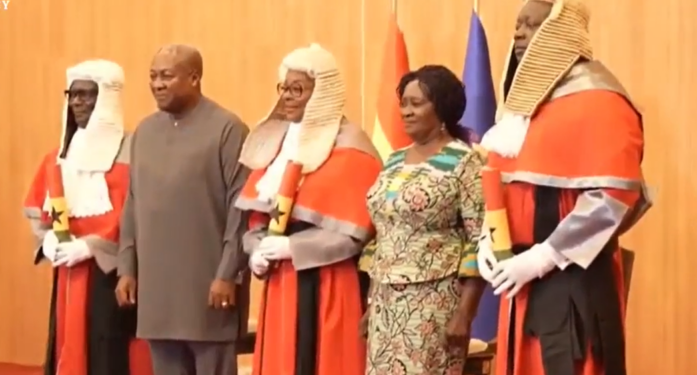
Aboagye's central complaint centres on what he describes as inappropriate closeness between judicial officers and government officials. He told the programme that the visible proximity between judges and the executive has become "blatant" and undermines confidence in the system.
He cited the handling of criminal cases during the legal vacation period as evidence of selective justice. Aboagye argued that if numerous cases—civil and criminal—are pending in courts, the decision to exempt certain defendants from criminal procedure during the legal break while others face prosecution amounts to discriminatory treatment.
"There is no way you can have a lot of cases in court, a lot of criminal cases, a lot of civil cases, some predating 2020, and then say that even though all of you are being tried in criminal cases, I have selected a few of you," he said, suggesting this represents unequal application of the law.
Aboagye revealed that he had written directly to the Chief Justice approximately a month ago to express his concerns about what he called the judiciary's "romance with the executive." Though he did not receive a personal response, the Judicial Secretary later issued a statement addressing some of his points—a gesture Aboagye acknowledged but said did not fully resolve his worries.
Why it matters for Ghana
These allegations strike at a fundamental pillar of democratic governance. When citizens—or credible political voices—question whether courts operate independently, they are questioning whether the rule of law itself remains intact.
Ghana's 1992 Constitution enshrines separation of powers and judicial independence as core principles. If significant sections of the population lose confidence that judges decide cases on legal merit rather than political affiliation or pressure, the legitimacy of the entire justice system erodes. Courts depend on public acceptance; without it, their rulings carry no moral force.
The timing of this protest also reflects broader tension in Ghanaian politics. High-profile criminal prosecutions have dominated the political landscape in recent years, with opposition parties frequently arguing that cases against their members are pursued more aggressively than those against government-linked individuals. The NPP's demonstration channels this sentiment into public action.
For ordinary Ghanaians, particularly those outside political circles, the implications are sobering. If the judiciary cannot be trusted to apply law fairly regardless of one's political connections, then the system offers little protection for the vulnerable. Rule of law becomes rule of the politically connected.
The broader context
Ghana's judiciary has faced mounting scrutiny from civil society and political actors in recent years. Questions about case backlogs, the speed at which certain cases progress, and visible interactions between judges and political figures have fuelled public discourse about independence.
The NPP's protest signals that these concerns now extend beyond academic debate into street-level political mobilisation. Party leaders frame the demonstration as a defence of institutional integrity rather than partisan attack, arguing that protecting judicial independence benefits all Ghanaians.
Whether the judiciary and government respond to these concerns—through deliberate distancing, clearer case management protocols, or public reaffirmation of independence—may determine whether public confidence stabilises or continues to decline.
Source: MyJoyOnline


Comments (0)
Be the first to comment.