
Mahama Sets Out Five-Point Framework as UK Signals Openness on Slave Trade Apology
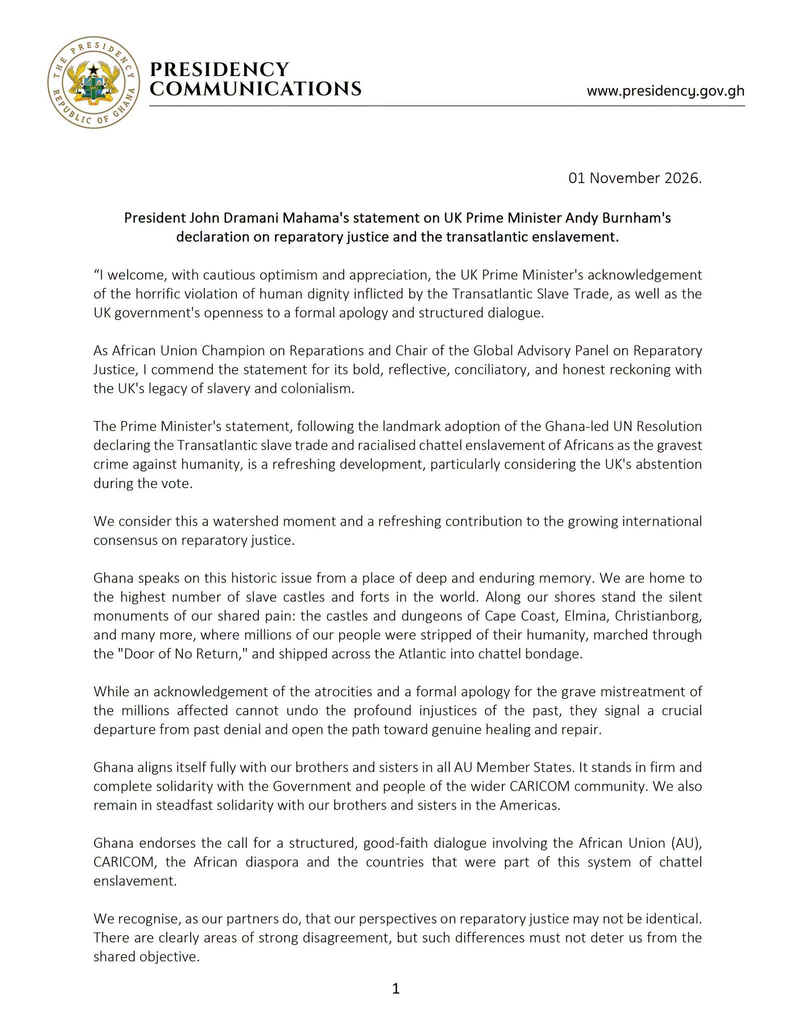

President John Dramani Mahama has responded positively to the United Kingdom's indication that it may be willing to issue a formal apology over the transatlantic slave trade, calling the development a watershed moment and presenting a structured five-point framework to guide what he hopes will be good-faith international dialogue on reparatory justice.
In a statement issued on Sunday, Mahama — who serves as the African Union Champion on Reparations and Chair of the Global Advisory Panel on Reparatory Justice — commended UK Prime Minister Andy Burnham for what he described as a bold and honest acknowledgement of Britain's historical role in slavery and colonialism. He stressed that while no apology could undo the immense suffering endured by millions of Africans, a formal recognition would mark a clear departure from decades of historical denial.
Ghana's Place at the Centre of This History
Few countries carry the physical weight of the transatlantic slave trade as visibly as Ghana. The country's coastline is dotted with slave castles and forts — among them Cape Coast Castle, Elmina Castle and Christiansborg Castle — that stand as grim monuments to one of history's darkest chapters. Through these sites, millions of Africans were stripped of their identities and marched through what became known as the Door of No Return, never to see their homeland again.
This history, Mahama argued, places Ghana in a uniquely important position to lead the global conversation on reparatory justice. The country recently spearheaded a United Nations resolution that formally declared the transatlantic slave trade and the racialised enslavement of Africans a crime against humanity — the gravest in human history. Notably, the UK abstained from that vote, making the British government's subsequent openness to dialogue all the more significant in Mahama's assessment.
Why It Matters for Ghana and Africa
The President's five-point framework sets out what he believes must anchor any meaningful reparatory justice process. First, he called for a formal apology from nations that participated in the slave trade. Second, he urged coordinated international action to dismantle systemic racism and Afrophobia wherever they persist. Third, he advocated for targeted investments in education, science, youth empowerment, climate resilience and healthcare in affected communities and nations. Fourth, he insisted on the restitution of stolen cultural heritage — an issue that resonates deeply across Africa, where museums in Europe continue to hold thousands of artefacts taken during the colonial era. Fifth, he called for strategic development partnerships designed to address structural poverty and the inequalities embedded in global economic and debt systems.
Mahama said the proposed discussions should draw on existing frameworks, including the Accra Next Steps Commitments, the CARICOM Ten Point Plan and the African Union's own declarations on reparatory justice. He reaffirmed Ghana's solidarity with African Union member states, the Caribbean Community (CARICOM) and people of African descent throughout the Americas.
The President also praised UK Foreign Secretary Ed Miliband alongside Prime Minister Burnham, arguing that confronting historical injustices honestly is an act of statesmanship, not weakness. He acknowledged that different stakeholders may hold varying views on specific aspects of reparations but insisted those differences should not derail a shared commitment to justice and reconciliation.
What Comes Next
While the UK has signalled openness rather than made a definitive commitment, Mahama's response suggests Ghana intends to use its AU champion role to keep the momentum going. The global reparations conversation has gathered pace in recent years, with CARICOM nations, several African governments and diaspora organisations all pressing for concrete action beyond symbolic gestures.
Ghana, Mahama assured, stands ready to work alongside the African Union, CARICOM, the United Kingdom and other members of what he described as a growing global coalition — one aimed at securing lasting justice, genuine reconciliation and a future free from racism and discrimination. Whether the UK translates its openness into formal policy commitments will be closely watched both in Accra and across the African continent.
Source: MyJoyOnline


Comments (0)
Be the first to comment.