After Year-Long Shutdown, Kwame Danso Police Station Reopens: Community Vows to Prevent Repeat Violence
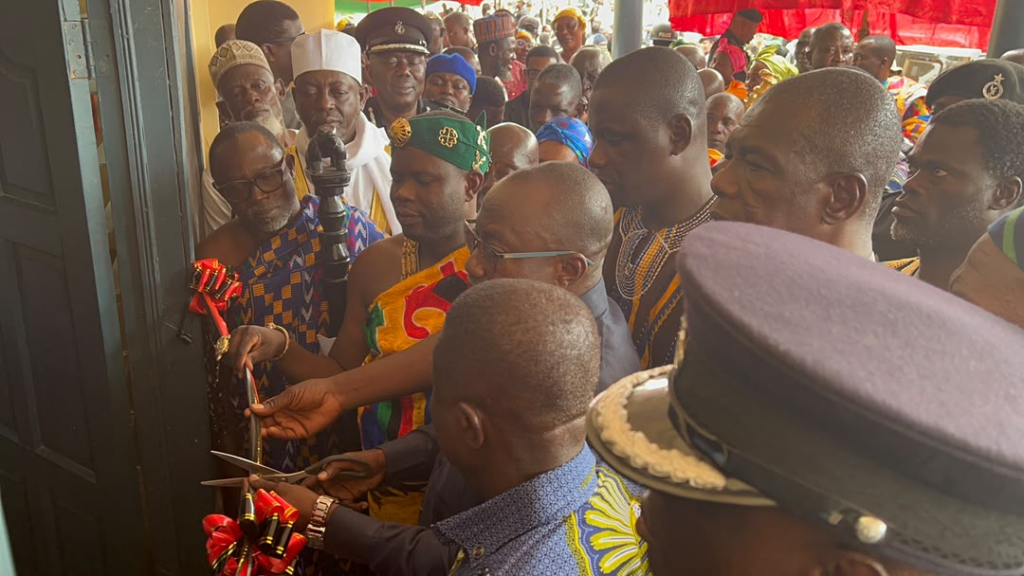
The Kwame Danso District Police Station has officially reopened its doors, ending nearly twelve months of unprecedented lawlessness that left residents without police protection, court services, or any formal mechanism for resolving disputes and reporting crimes.
The extended closure stemmed from violent events on December 10, 2025, when approximately 100 youth stormed the district court, disrupted legal proceedings, vandalised property, and forced the release of remanded suspects. The mob then attacked the police station itself, prompting the Inspector-General of Police to shut down operations indefinitely. The Judicial Service Staff Association of Ghana simultaneously withdrew court staff, citing safety concerns for their members.
The Human Cost of Absence
For twelve months, Kwame Danso residents experienced the stark reality of a district without law enforcement. Businesses operated without legal recourse. Crime victims had nowhere to report offences. Disputes that would normally be resolved through formal channels were settled privately, often dangerously. Criminal suspects simply remained free within the community.
At the reopening ceremony, District Chief Executive Khaari Fuseini acknowledged the scale of the community's suffering. "The closure affected everyone in this area," he stated. "We have suffered. We have learned. And today, we say welcome back to our police." Visibly emotional, Fuseini issued a public apology for the circumstances that triggered the shutdown and pledged that such incidents would never recur in Kwame Danso.
Residents expressed cautious relief mixed with determination. A local farmer named Kwame described the past year as "the hardest" for the community. "We couldn't report anything. If you had a dispute, you had to handle it yourself. It was dangerous," he explained. A trader, Adwoa, captured the community's resolve: "We are happy the police are back. But we also know we must behave ourselves. We don't want them to leave again."
Rebuilding Trust and Preventing Future Conflict
Regional Police Commander DCOP Shaibu Sadique-Osei characterised the December attack as "a dark day for law enforcement," but adopted a forward-looking tone. "We are back, and we are back to stay," he declared. "Our mandate is to ensure law and order, and we will do so without fear or favour." He stressed that security remains a shared responsibility between police and community members.
Regional Minister Francis Owusu Antwi reinforced this message, arguing that development cannot occur without security. "The police prevent crime, protect lives and property, and they do so at great personal risk," he said, urging residents to view officers as development partners rather than adversaries.
Traditional authorities have played a crucial role in preventing escalation. The Omanhene of Dwan Traditional Council, Okoforbour Awase Afura III, disclosed that chiefs had conducted extensive community engagements with youth to discourage future violence. "Enough engagements have taken place to sensitise the youth not to take the law into their own hands again," the Omanhene stated. "Those who do will be dealt with according to the law."
What This Means for Ghana's Justice System
The Kwame Danso closure highlighted a critical vulnerability in Ghana's decentralised security infrastructure. The extended shutdown demonstrated how concentrated mob action can completely collapse formal justice mechanisms in smaller districts, leaving communities vulnerable and creating space for informal, potentially extrajudicial dispute resolution.
The reopening marks a significant but incomplete restoration of the district's justice system. While police operations have resumed, the reopening of the district court remains pending with no announced date. Security analysts note that the true measure of success will not be the physical reopening but whether the community and police can rebuild mutual trust following such a profound rupture.
For now, Kwame Danso residents are cautiously optimistic. The return of the police station represents more than bureaucratic reopening; it signals the restoration of formal legal pathways that most Ghanaians take for granted but that residents lived without for an entire year. Whether that restoration proves durable will depend on sustained commitment from both law enforcement and the community to prevent a repeat of December 2025's violence.
Source: MyJoyOnline

Comments (0)
Be the first to comment.