UGMC Releases Michael Blackson's Mother's Body Despite Outstanding Medical Bill, Defends Treatment Approach
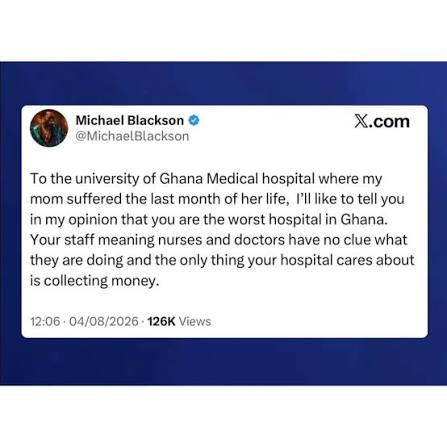
The University of Ghana Medical Centre has defended its decision to release the body of Ghanaian-American comedian Michael Blackson's mother for burial despite an outstanding medical bill, citing its commitment to prioritising patient care over immediate payment collection.
Following the death of Blackson's mother on July 16, 2026, after an eight-week admission at the facility, the comedian publicly criticised the hospital for what he perceived as excessive focus on financial charges. In response, Dr Baffour Gyan, UGMC's Director of Medical Affairs, clarified the institution's billing philosophy during a statement on Friday, August 7, 2026.
How UGMC's Billing System Works
Dr Gyan explained that the hospital operates under a treatment-first, billing-after model designed to ensure that financial constraints do not prevent patients from receiving urgent medical care. Under this system, patients and families are presented with a consolidated bill only after treatment is completed, rather than receiving itemised charges throughout their hospital stay.
This approach, whilst intended to remove financial barriers to care, can create misunderstandings when families see the accumulated costs for the first time. A prolonged admission involving intensive care, multiple laboratory tests, specialist scans, medications and advanced medical interventions can result in a bill that appears surprisingly large when presented as a single total.
Dr Gyan acknowledged that such consolidated billing may shock families unfamiliar with the cumulative nature of hospital expenses, particularly in cases requiring specialised treatment and continuous monitoring over several weeks.
The Cost of Intensive Care
According to Dr Gyan, the final cost of medical treatment depends significantly on the patient's condition and the level of specialised intervention required. Patients spending several weeks in intensive care units require continuous monitoring, specialised equipment and advanced medical procedures, each of which adds to the overall expense.
The UGMC director stated that the facility's foundational principle is straightforward: patients should receive the care necessary to save their lives first, with billing and payment arrangements handled separately afterward. This prioritisation reflects the hospital's commitment to medical ethics and patient welfare over revenue collection.
Why This Matters for Ghana
This case highlights ongoing tensions in Ghana's healthcare system between the need for hospitals to maintain financial viability and the principle that medical treatment should not be withheld due to inability to pay immediately. UGMC, as a major public teaching hospital affiliated with the University of Ghana, serves patients from across socioeconomic backgrounds.
The situation raises important questions for Ghanaian families about understanding hospital billing systems, the true costs of intensive and prolonged medical care, and how to prepare financially for serious health emergencies. For patients and relatives unfamiliar with healthcare economics, the sudden presentation of large bills after extended treatment can feel financially devastating and, in some cases, exploitative—even when hospitals are genuinely prioritising care.
The incident also underscores the need for clearer communication between healthcare facilities and families during treatment, particularly regarding potential costs associated with extended care, so that billing does not overshadow legitimate concerns about medical quality or value for money.
Source: The Ghana Report


Comments (0)
Be the first to comment.